XX001 3 x 3 cm bases (square) These are used for the majority of Peter Pig rule systems. Usually used for infantry. 40 Bases in a pack. £4.80
XX002 3x 4 cm bases (rectangular) Usually used for cavalry and equipment. 40 Bases per pack. £4.80
XX003 4 x 4 cm bases (square) These are usually used for guns and generals. 10 Bases per pack £3.50
The famous Piggy Dice £6 Pack 0f 12 Choose colour All dice are 16mm size. Piggy on the 6.
16mm dice. Peter Pig were the first to produce dice with piggy head on the 6 (instead of the traditional 1 in 2003). Another innovation from Peter Pig. w
Black (xx201)
Dark orange (xx202)
Orange (xx203)
Kawasaki green (xx204)
British racing (dark) green (xx205)
Blitzkrieg (dark) grey (xx206)
Spitfire (light) blue (xx207)
Mid blue (xx208)
Pink (xx209)
Ivory (xx210)
Yellow (xx211)
(XX004) Pair of choice dice 2 faces "I choose" 4 Faces blank. Used when a player wishes to choose the location of the casualties inflicted. Used in some Peter Pig rules. £1.50 per pair
Peter Pig 15mm figures Peter Pig is one of the world's leading 15mm figure manufacturers. We make 6000 different figures and models. These are distilled into 1800 (15mm) packs. Every range has an associated set of rules. Also, there are related 15mm scenery ranges to accompany the figure ranges. In these days of wandering measures of sizes into 18mm, 12mm and other sizes close to 15mm; Peter Pig has remained true to the 15mm ideal. These other sizes are often an attempt by a manufacturer to create a market for just their peculiar size. It is also used by sculptors who cannot work well with the 15mm size restriction and so need extra size in order to create acceptable sculpts. Peter Pig will continue to do 15mm wargame figures. We will also constantly return to each range in order to carry out updates and additions. Thus we have 15mm ranges with longevity and future potential.
Period of Warfare covered War on the colonised planets AD2222. Peter Pig games always cover a narrow period in order to capture that period. Thus the most important aspects of that war can be modelled and the less important ones piled into the general mechanisms.
TCR is a game set in a plausible future.
Small number forces attack each other in small actions centred around resources.
Scale Each square = 300 metres. Each model figure represents 1 real soldiers.
Game setting Small raiding force versus defence force.
Associated Peter Pig range Range 12 Range 12- The Company Rules. A complete range of figures and items to play TCR. Peter Pig always makes sure that the necessary stuff to play the game is available.
Game scenario generator An “Approach” grid.Both players manoeuvre up and down a grid in order to try to arrive at an advantageous level (5 minutes).
Game table size 5 by 3 feet . Gridded into 6 inch squares. Peter Pig games should fit on a normal living room table.
How much scenery needed 7 of 6x12" templates per player. Players do get choice over scenery piece types. In PP games both players take a full part. No alpha player choosing the armies, scenery, scenario and victory conditions. Peter Pig games use templates to represent scenery areas. The trees and houses are indicative, not literal. Players could avoid using templates and just place appropriate scenery in squares.
How many D6 needed 10 D6 in total. Typically need 4D6. Piggy games allow a bunch of D6 to be rolled in order to bell curve the outcomes i.e. results group around the norm but extremes are possible.
Measurement method Grid system. 6" squares. You could measure in multiples of 6" if grids are an anathema? If measuring has to be very accurate, time is wasted and cheating/errors can occur.
Basing convention Base size is not imperative, because it is a grid system. Peter Pig rules use 3x3 cm bases for most troop types. This size is tactile. has the same frontage when turned and allows figure formations to have depth as well as width.3x3 cm bases for 2,3 or 4 figures.
Typical force composition Typical force= 10 foot bases (20 figures). Most PP games use about 100 figures a side. enough for PP to make some big sales and not too many to paint.
Number of army composition lists included A choice of 7 forces. 1. Authority 2. Precinct 3. Distance 4. Free staters 5. Indies 6. Bonkers 7. Creepers (The aliens)
Most forces you already have can fit into one of these categories/force types.
Motivation mechanism Each base (usually about 9 per player) acts independently.
Action/moving mechanism TCR is fast game. This helps give pace and feels as if the action is unfolding quickly. All the mechanisms can be quickly used and remembered.
Each base may only carry out 1 action per own turn. Choose:- Shoot, move, put up blockers, launch mine. Multiple bases can be in the same square.
Shooting mechanism Roll 2- 6D6. Each pair = a hit.
Morale mechanism None.
Game length A chaser moves around the table edge. D6-2 squares per turn. One loop of the table= game duration.
Book keeping Usually a few numbers to write down at the beginning but nothing after that. Most games have a battle/planning sheet available as a free download on the PP website. None after pre-game.
Principal victory condition The two sides have different criteria to win. Most victory conditions are awarded D6 multiples so their exact worth is not known until the game end.
Best parts Bits we really like about the game. 1. Communication system. This creates reinforcements, air strikes etc. 2. Assaults. They can change the situation. 3. Scenery set up. Both players take part. No alpha gamer having it all set up before anyone arrives. 4. Choice of armies.
TCR Game pictures
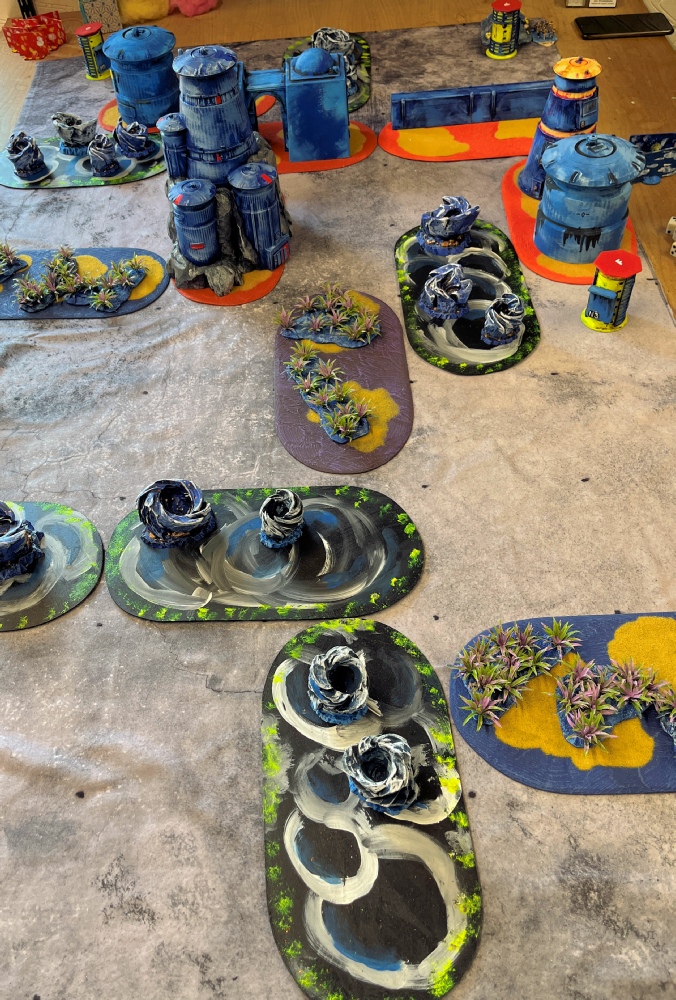
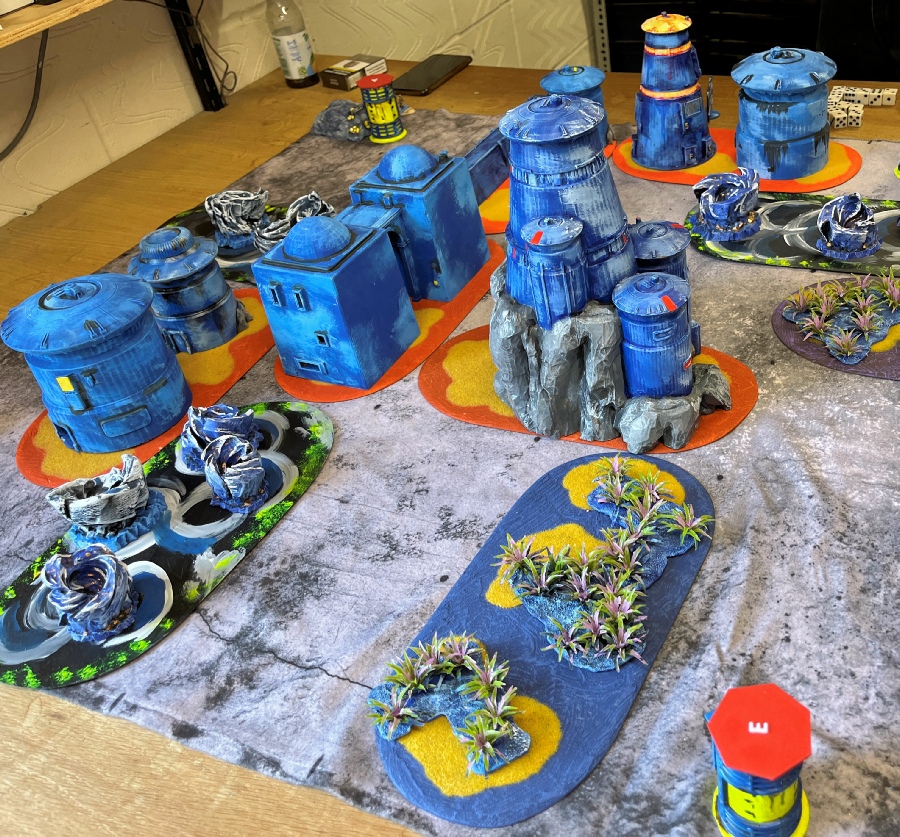
A couple of pictures. These show the game table all set up. The two players each choose 7 scenery pieces. The types are horror (eats people), buildings and vegetation. The table is 10 by 6 squares. You can see the small dots that mark the grid.
Horror (swirly) imposes a risk to those bases that pass through it. It is difficult to get out of. Buildings (red) are harder to move through but do giver anodine cover. Vegetation also gives cover and is easy to move through.
There are 6 objectives- the point of the game. The attacker wants to destroy these. The defender wants to defend them.